
The Muskoka Road Ramble

The Muskoka Road Ramble is a guided stroll down Muskoka Road, telling the story of how the Homesteader’s Act led to settlement that established Gravenhurst as both a lucrative industrial hub and thriving vacation retreat. See below for information and an audio clip for each location.

Welcome to Muskoka!

In 1859, the Canadian government announced that it would allow the creation of a road from Washago into Muskoka, promising that land grants would be available to those who settled in this newly accessible region. By 1868, the Homesteader’s Act solidified these land grants, ensuring that anyone approved for settlement would be allocated 100 acres of land, however to take ownership of the land at no cost, the settler would be expected to clear a minimum of fifteen acres, build a home at least sixteen by twenty feet in size, and continuously cultivate the land within the first five years of possession. 

To build their Muskoka Dream, settlers had to travel down Muskoka Road, which you’re walking on today, though it looked very different when Gravenhurst was first being settled. The road itself started as a rough path through dense forest and very mucky swamp. Settlers worked together to create a corduroy road, which was made by cutting down trees and laying them side-by-side to create a road that was easier for horses to travel across. These roads were not without their challenges- they often shifted and floated in Spring when the water table was high.

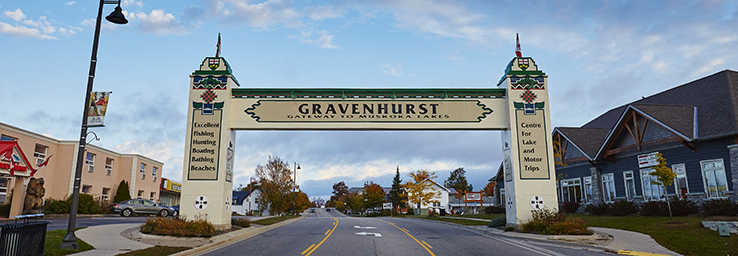
In 1874, settlement was beginning to boom, and word about this incredible region full of fresh air, clean lakes, and tall trees was out. The Governor-General, the Marquis of Dufferin, announced that he would be coming for a visit, so the settlers created an arch made from pine boughs and flowers draped over Muskoka Road to welcome him. In the years that followed, four more arches have been erected in Gravenhurst to welcome visitors

The arch that stands today is a reproduction of the 1925 arch. Visitors would be excited to learn about the excellent bathing and hydro-electric power available in Gravenhurst at that time.

Link to Audio Clip

McCabe's Landing

The blocks between Caroline Street and Main Street, with the St.James Anglican Church cemetery in the middle, were the location of Lot 6, the parcel of land granted to Gravenhurst’s first settlers, James & Letitia McCabe in 1859. They called their homestead McCabe’s Landing, which was the name people used for the region until a post office was established in 1862 and the community was officially named “Gravenhurst”.  

Once their home was built, the McCabes built a tavern with accommodations and outfitting services. The outpost, known as “The Freemason’s Arms,” was noted in Cecil Porter’s book Gravenhurst: Early Days, Early Ways as advertising that “Boats & Fishing Tackle [were] always on hand for the convenience of Parties.” “The Bar was always well supplied with fine liquors and cigars,” though historian Geraldine Coombs notes that Mrs. McCabe was known to stir their signature drink (made of water, vinegar, and molasses) with her bare hand. 

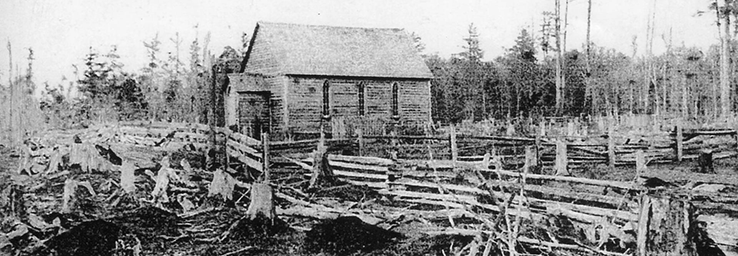
The McCabe family was known for their kindness and generosity. After officially acquiring Lot 6 in 1864, they donated one acre to the Anglican Church, where members established this cemetery and built a church so travelling clergy no longer needed to hold services at The Freemason’s Arms. With an increasing population, the church became too small and a new one was built in 1882, which sadly burned in 1887. It was rebuilt and still stands in the same plot at the corner of Hotchkiss and John Streets today.

Link to Audio Clip

Outdoor Art

Downtown Gravenhurst is filled with outdoor art, often in the form of large murals and graphic installations adorning local businesses. The building beside the train crossing on Muskoka Road South proudly showcases artwork created by Grade 9 students from Gravenhurst High School, inspired by their teacher, Sue Buckingham. The installation features seventeen panels depicting the changing of seasons using a pop-art and cloisonism style. 

Additional murals can be found downtown, each showcasing a scene that tells the story of Gravenhurst’s industrial growth. One of these murals showcases the lumber trade, which began to boom in the mid-1800’s and waned in the late twentieth century as lumber demand shifted. Two other murals display railway and steamship use, which were the most efficient way of moving both people and goods throughout the region. They are both still active today. Another mural highlights the ice industry, which provided winter employment as local men cut massive slabs of crystal-clear ice from both Gull Lake and Lake Muskoka, storing them in piles of sawdust to preserve them through the warmer months. 

Gravenhurst’s newest mural is located at the corner of Muskoka Road South and Hotchkiss Street. This mural was commissioned by Muskoka’s Inclusivity, Diversity, Equality, and Anti-racism (IDEA) task force, which also installed murals with the same mission in both Bracebridge and Huntsville. Gravenhurst’s mural was designed by Toronto artist Jim Bravo, and in 2023, he worked with local painter Steph Schofield to bring it to life. The mural’s bright colours bring inspiration to everyone exploring downtown, with images that depict collaboration, nature, and common Muskoka pastimes.

Clip to Audio Clip

Downtown Businesses & Hotels

Gravenhurst’s downtown has been ravaged by fire many times in its history, with the largest loss being the Great Fire of 1887; however, Gravenhurst residents have always been resilient people. The early residents of Gravenhurst continually came together with resilience and determination, rebuilding and moving forward after each hardship they faced. 

All of the original buildings between Phillip Street and Harvie Street were unfortunately constructed with wood and did not survive the fire of 1887. Soon after, a mix of common sense and new law inspired most downtown buildings to be constructed with brick. Many of those buildings still survive today. 

At the intersection of Muskoka Road South and Sharpe Street, the Gravenhurst Opera House stands kitty-corner to the former Gilmour Hotel. The Opera House is a grand Gothic Revival-style building whose original purpose was to house both a community performance space upstairs and the town hall on the main floor. Though in 1901 the residents appreciated the addition of this key community hub ,at the time, many balked at the $5000 cost required to complete the structure. 

Down the sidewalk at 155 Muskoka Road South, you’ll find a building where delicious meals have been served for over 100 years. In 1915, Gravenhurst’s first police chief Archy Sloan opened Sloan’s Restaurant, which featured bench-style seating, a community hall, and legendary blueberry pie that people would drive long distances to enjoy. The restaurant name has changed in recent years, but this historic culinary destination is still serving quality food with hometown ambiance. 

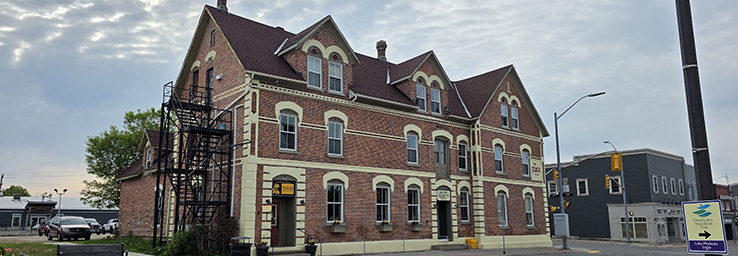
Two more noteworthy buildings can be found at the intersection of Muskoka Road and Bay/Brock Streets. The Albion Hotel was built on the north-east corner in 1879, was destroyed by the Great Fire of 1887, and then rebuilt in the Gothic Revival style to reopen in 1888. In 1867, the Steamboat and Stage Hotel stood on the property across the road. It was sold to become the Fraser Hotel but was lost in the Great Fire of 1887. The Windsor Hotel graced this site shortly after, only to burn to the ground in 1903. The lot sat empty for 10 years until the Federal Government purchased it in 1913 to build a post office. The Great War however paused plans until 1926, when a one-storey brick post office was erected, with a second floor and other upgrades added some years later. Both the Albion Hotel and Post Office buildings have been designated Heritage Properties by the Town of Gravenhurst.

Link to Audio Clip

Stay up to date

Sign up to our newsletter